Frequently Asked Questions
The most-asked questions about swimming & water sports.
What does the term 'swimming & water sports' actually cover?
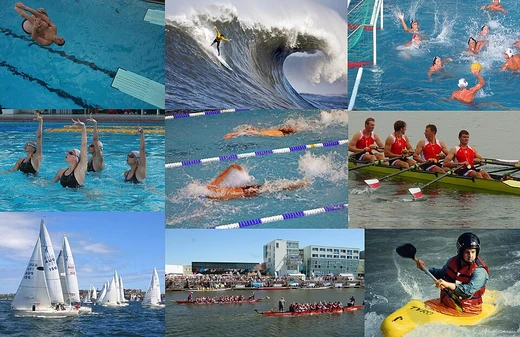
It is an umbrella category for every athletic discipline performed in or on water, including pool racing (freestyle, backstroke, breaststroke, butterfly, medley, relays), open-water swimming, diving, synchronized swimming, water polo, and high diving. All of these fall under the international jurisdiction of World Aquatics.
Who are the most iconic names in the sport's history?
Michael Phelps, with 23 Olympic gold medals, and Mark Spitz, who took seven golds at the 1972 Munich Games, are widely regarded as the all-time legends. In the current generation, Katie Ledecky and Caeleb Dressel are the most frequently discussed athletes, while Greg Louganis and Dale Honeycutt anchor the diving and water polo pantheons.
What are the main competitive disciplines a newcomer should know?
Pool swimming is split into four individual strokes plus the individual medley and various relay formats, all raced over 50 m, 100 m, or 200 m (with 400 m freestyle and 4 × 200 m freestyle relays as exceptions). Beyond that, the family includes 1 m and 3 m springboard diving, 10 m platform diving, synchronized swimming, water polo, and 5 km / 10 km / 25 km open-water events.
Where should a complete beginner start learning to swim?
Most coaches recommend beginning in a shallow pool with front-crawl (freestyle) technique, concentrating on rhythmic breathing and horizontal body position before worrying about speed or distance. A certified Level 1–3 swimming instructor, a community-center lap program, or a local swim club's introductory course are the most common on-ramps.
Which organization governs the sport worldwide?
World Aquatics, based in Lausanne, Switzerland, writes the rulebook, ratifies world records, and stages the World Championships for every aquatics discipline. National federations such as USA Swimming, Swimming Australia, and the British Swimming body handle domestic competition, athlete development, and anti-doping at the local level.
What are the biggest competitions on the annual calendar?
The Summer Olympic Games and the biennial World Aquatics Championships are the two marquee events that draw the largest global audiences. Continental championships, the World Aquatics Series of invitationals, and each country's national trials fill out the rest of the competitive season.
What is one of the most talked-about moments in swimming history?
Mark Spitz's seven-gold-medal haul at the 1972 Munich Olympics set a single-Games record that lasted 36 years and made him a cultural icon. Michael Phelps's eight-gold sweep at the 2008 Beijing Games is still cited as the most dominant individual performance in any Olympic sport.
How does competitive swimming differ structurally from other water-sport disciplines?
Swimming is a timed race where the first athlete to touch the wall wins, so results are purely objective. Diving and synchronized swimming, by contrast, are scored by panels of judges on technique, synchronization, and execution, while water polo is a team contact sport and open-water events introduce currents, waves, and mass-start dynamics.
Which records do fans and analysts track most closely?
The 100 m freestyle world record, currently 46.97 s set by Kristóf Milák in 2019, and the 200 m individual medley are among the most-watched benchmarks in pool racing. In open water, the Olympic 10 km men's and women's titles and the World Championship equivalents generate the largest international viewership.
What makes swimming & water sports unique among Olympic disciplines?
Water itself is both the playing surface and a constant physical variable that shapes technique, pacing, and safety in a way no land-based sport replicates. Because one federation oversees everything from 50 m sprints to 25 km open-water marathons and 27 m high diving, a single athlete can compete across radically different formats on the same international circuit.